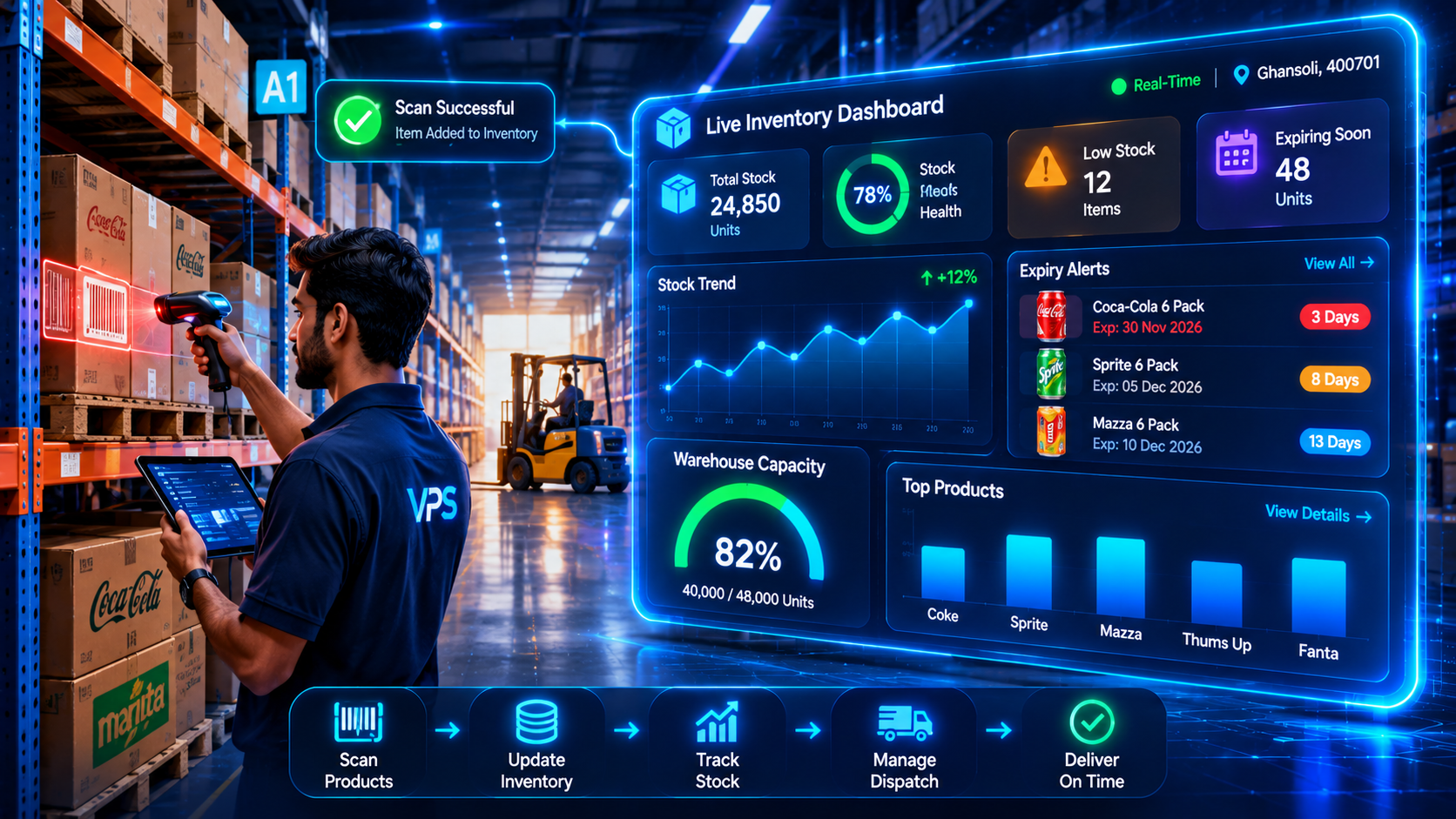
Warehouse Management Systems in India: What Distributors Need in 2027
Excel inventory works until it does not. The five capabilities a 2027 warehouse system needs — and the cost of getting them wrong.
Why Excel inventory breaks at exactly the wrong time
Every distributor starts the same way: a master Excel sheet, a couple of trusted people who "know the stock," and WhatsApp messages confirming orders. It works beautifully — right up until you add a second warehouse, a third salesperson, or 500 SKUs.
Then the failure modes arrive together: two people edit the same sheet, stock numbers disagree with physical counts, expired stock sells because nobody checked dates, and month-end reconciliation takes days. The software did not fail — the model did.
The five capabilities that matter in 2027
- Real-time stock visibility — one source of truth across godowns, with every order, return, and adjustment logged to a person and timestamp.
- Expiry and batch tracking — FEFO picking, near-expiry alerts, and write-off reports that protect margin automatically.
- Employee order portal — sales staff place orders through a branded mobile-friendly portal with credit limits enforced by the system, not by memory.
- Invoicing and GST-ready documents — orders convert to invoices with correct tax fields, dispatch notes, and outstanding tracking.
- Reports that answer real questions — slow movers, stock value by godown, customer-wise turnover, and margin by product — without spreadsheet gymnastics.
The credit-control problem most WMS ignore
Indian distribution runs on credit — and credit runs on trust. The expensive failure is not a customer defaulting once; it is a pattern you never saw because order history lived in a WhatsApp thread.
A proper system enforces credit limits at order time, tracks aging per customer, flags unusual order sizes, and gives the owner a daily view of exposure — turning collections from a monthly panic into a managed process.
Barcode, QR, or nothing?
You do not need a ₹50 lakh automation line to get 80% of the benefit. A smartphone camera scanning QR codes on racks and SKUs eliminates most manual entry errors — the single biggest source of inventory shrinkage.
Start with QR-based scanning and a clean data model; add barcode hardware or integrations later if volume justifies it. The mistake is buying hardware before fixing the data.
Build vs packaged WMS
Packaged WMS products (SAP B1, Tally-integrated tools, generic ERPs) are built for generic inventory — they handle stock but not your credit rules, your distributor tiers, your Hindi/English invoice formats, or your WhatsApp ordering flow.
A custom WMS built around your actual godown layout, product categories, and customer credit structure costs more upfront but eliminates the workarounds your team currently runs on Excel and WhatsApp — which is where the real money leaks.
What a realistic rollout looks like
Phase 1 (week 1–2): digitise the master data — items, godowns, customers, opening stock. This is unglamorous and non-negotiable.
Phase 2 (week 3–6): orders, dispatch, and invoicing live; Excel becomes read-only backup.
Phase 3 (month 2+): expiry automation, credit dashboards, and reporting tuned to how you actually review the business.
Parallel-run the first two weeks of go-live — trust is earned by matching numbers, not by deadlines.
Frequently asked questions
How much does a warehouse management system cost in India?
Packaged WMS tools run ₹1,500–10,000 per user per month plus implementation. A custom WMS for a distributor typically costs ₹5–15 lakh to build, then runs on modest VPS hosting — and encodes your exact credit, expiry, and ordering rules.
Can a WMS work with WhatsApp ordering?
Yes — with the WhatsApp Business API, customer orders arriving on WhatsApp can flow into the system for confirmation, picking, and dispatch updates, all logged against the customer record.
Do my staff need training for a new WMS?
A well-designed system needs minimal training — staff already know order-taking and dispatching; the software just replaces the spreadsheet. Most rollouts include a short hands-on session per role.
What about GST compliance in a custom WMS?
Invoices can be generated with GST fields (HSN, tax rates, place of supply) matching your CA’s requirements. Final GST filing typically stays with your accountant — the system produces clean data they can work from.
Building something like this?
Tell us how your business works — we'll design the system around it in a fixed-scope sprint.
Book a free architecture call